
I make my living the slow, old-fashioned way: writing songs, practicing until my fingers hurt, saving up to record, and praying a few people hit “play” instead of “skip.” So when people ask, “Can’t someone just use AI to make music and copyright it?” I feel that in my gut—because that’s my rent, my groceries, my guitar strings you’re talking about.
The good news (for humans) is that the law is starting to back us up when it comes to AI Music Copyright. Courts and copyright offices are drawing a line between a real human artist and a piece of software generating sound on command. That matters for every musician trying to make it legit, without being replaced by a prompt.
AI Music Copyright and Why Humans Still Matter
In plain English: in the United States and many other countries, music created entirely by AI, with no real human creativity involved, cannot be copyrighted.
The U.S. Copyright Office has made it clear that copyright protection requires human authorship. If a track is purely AI-generated, with no meaningful human creative input, nobody can really own it in the legal sense. No label, no tech company, no random person can grab a fully AI-only track and claim exclusive rights in it. AI-generated music like that sits in a kind of copyright gray zone that behaves a lot like the public domain.
For musicians, that’s crucial. It means AI shouldn’t legally be allowed to show up out of nowhere, replace us, and then lock its “songs” behind legal walls as if it were a human songwriter. Copyright law is still built around people, not machines.

When Courts Say “No” to AI-Only Authorship
One of the most important cases in this area is Thaler v. Perlmutter. In that case, an inventor tried to register a work where the “author” was listed as an AI system called the Creativity Machine. The U.S. Copyright Office refused, and the court agreed: works created solely by AI cannot be copyrighted because the Copyright Act requires a human author.
That case isn’t about music specifically, but the logic absolutely applies to music. If a track is generated end-to-end by a model with no real human creative control, there’s no copyright. And if there’s no copyright, there’s no publishing deal, no performing rights registration, and no legal monopoly on that track. Anyone could technically reuse or redistribute that audio without infringing.
Another important example comes from the visual art world: the “Zarya of the Dawn” graphic novel. The creator used an AI tool (Midjourney) to generate images but wrote the text and assembled the story by hand. The Copyright Office eventually decided that the human-written text and the creative way everything was arranged could be protected, but the purely AI-generated images themselves could not.
For those of us in music, that sends a clear message: using AI as a tool is allowed, but the protectable part is what you actually create. If you use AI to spark ideas and then you write original lyrics, shape melodies, arrange the song, perform the parts, and produce the track, your human contributions can still be protected by copyright. AI can be part of your workflow, but it doesn’t replace the need for real human creativity.

When AI Crosses the Line: Training Data and Lyrics
The big battles right now aren’t just about the sounds AI spits out; they’re also about what these models are trained on. A lot of AI systems have been fed massive catalogs of copyrighted songs and lyrics without asking the artists or paying them.
That’s exactly what’s being challenged in lawsuits like the one where music publishers (including companies tied to Universal Music Group and others) sued the AI company Anthropic. They argue that Anthropic used copyrighted lyrics to train its model and then allowed users to generate those lyrics on demand. The case is still unfolding, but the core point is simple: if you’re training AI on our songs and letting it recreate our work, you should be paying the people who wrote those songs.
In Europe, things are heating up too. A German court ruled that reproducing certain song lyrics through an AI system can violate copyright law if those lyrics were used without permission. That’s a strong signal that, internationally, artists and rights organizations are pushing back against the idea that our work is just “free training data.”
All of this points toward a future where AI companies will need to license music catalogs the same way streaming services do. If Spotify has to pay to stream my song, then an AI company should have to pay if it’s going to learn from that same song and use it to generate its own content.
How AI Should Be Used Without Stealing from Musicians
As a working musician, I don’t see AI as pure evil. I see it as another tool in the studio – like a sampler, a synth, or a drum machine. The problem isn’t the tool; it’s how it’s used and who gets paid.
In my opinion, AI should be used in ways that support, not replace, real artists:
- AI as a creative assistant: generating rough demos, chord progressions, drum grooves, or orchestral mock-ups that a human then reshapes and records for real.
- AI for inspiration, not duplication: using it to spark new ideas, not to copy specific artists’ styles or lyrics without permission.
- AI in practice tools: backing tracks, ear training, and learning aids that help musicians develop their skills instead of bypassing them.
The key is that there’s still a human being making the final creative decisions, adding emotion, and taking responsibility for the work. AI is part of the workflow, not the “artist” replacing everyone on the payroll.
Transparency matters too. If a track is heavily AI-assisted or fully AI-generated, it should be labeled as such. That protects listeners who want to support real musicians, and it keeps platforms honest about what they’re promoting and monetizing.
Building a Fair Future for Human Artists
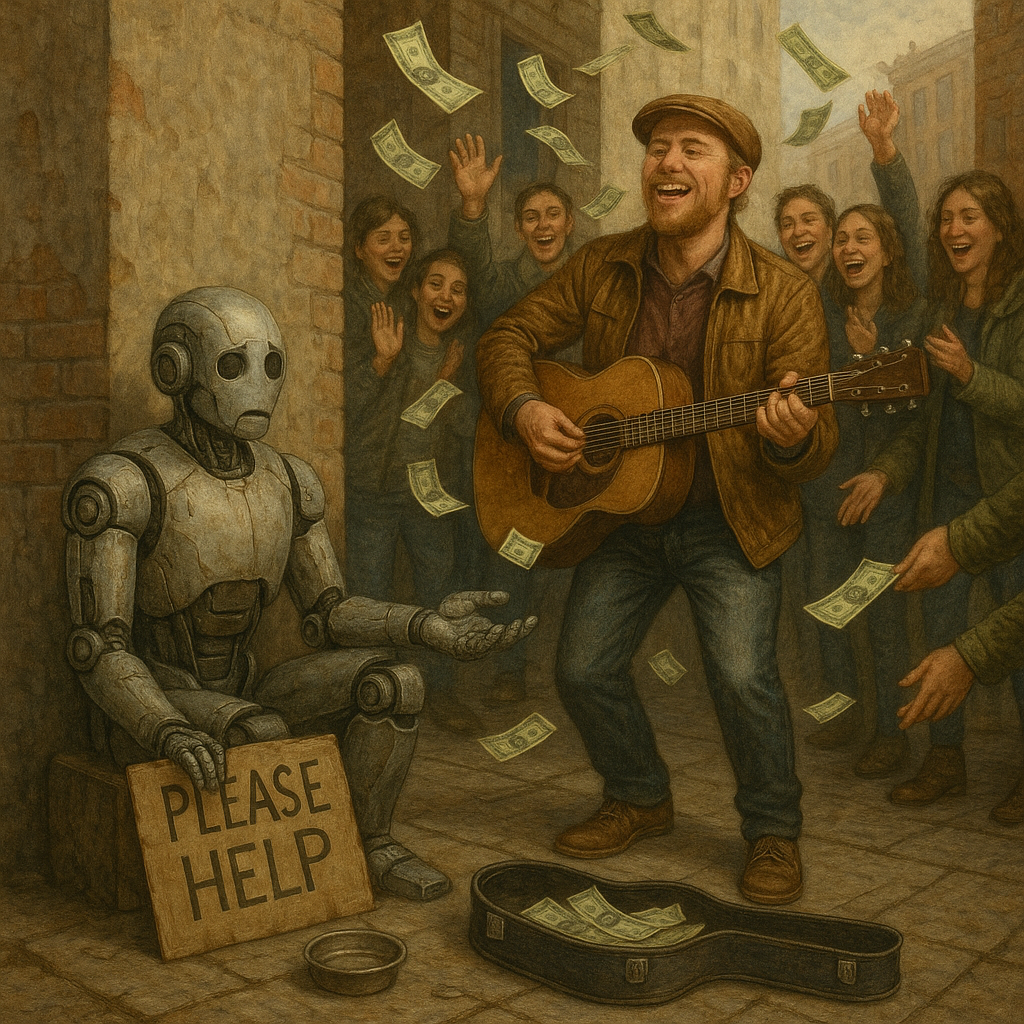
I’m not afraid of technology. My sessions are full of DAWs, plugins, virtual instruments, and digital tools. What I am afraid of is a future where labels and tech companies flood playlists with AI tracks they don’t have to pay royalties on, drowning out the songs made by people who are actually living the stories they sing.
The legal trend is cautiously on our side: courts are saying AI-only works can’t be copyrighted, copyright offices are reinforcing that human creativity is the core requirement, and artists and publishers are going to court to demand that training and output respect our rights.
That doesn’t mean AI disappears. It means AI will have to fit into a system that recognizes our value instead of quietly siphoning it.
If you’re another musician reading this blog about AI Music Copyright, here’s my honest takeaway: use AI as a tool if it helps you, but protect your human contributions. Speak up for licensing and fair pay when your songs are used to train machines. And don’t let anyone convince you that your blood, sweat, and late-night sessions are interchangeable with whatever falls out of a random prompt.
AI can help create tracks. Only we can create music that truly comes from a real, lived human life.